
The third cohort of the SystemLink graduate college at RPTU Kaiserslautern-Landau has launched a large-scale continental field study across Europe to understand how environmental stressors drive changes through aquatic–terrestrial ecosystem interactions.
Continue readingTag Archives: aquatic-terrestrial linkage
Light pollution and invasive species: how spiders’ diets change
Night-time lighting and invasive species are changing food webs in ways we rarely notice. In this blog post, Collins explores how artificial light at night and invasive signal crayfish reshape spider diets and alter aquatic-terrestrial resource pathways.
Continue readingA synthesis of research related to aquatic-terrestrial coupling through emergence-mediated contaminant transfer
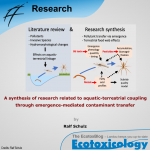
In this blogpost, Ralf Schulz talks about a recent review paper summarizing the newest literature on how anthropogenic stressors, such as pollutants, invasive species and hydromorphological changes in aquatic ecosystems affect the aquatic-terrestrial ecosystem coupling and particularly the food webs in terrestrial recipient food webs.
Continue reading12 doctoral research positions in SystemLink at Campus Landau
The DFG-funded research training group ‘SystemLink’ at University of Koblenz – Landau is offering 12 doctoral research positions as part of its second cohort.
Continue readingYear in Review – Part 3
In the third installment of the ‘Year in Review’ series, we present our readers a glimpse of the last lot of most visited posts in the year 2021.
Continue readingA mini-review of process-based food web models and their application in aquatic-terrestrial meta-ecosystems
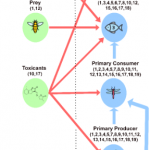
In this post, Stephen Osakpolor talks about his review of process-based food web models for both aquatic and terrestrial ecosystem. These models are essential for understanding how stressors affect the interconnected environments.
Continue readingSave the date: SystemLink virtual conference on aquatic-terrestrial linkages on January 28 & 29
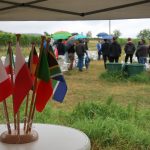
The SystemLink graduate school at the University of Koblenz Landau, Institute of Environmental Sciences (iES), will host a free virtual research workshop on the topic of anthropogenic alterations of aquatic-terrestrial linkages.
Continue readingChemicals cross boundaries: New book highlights the water-land interface
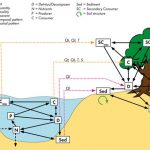
In this post, Mirco Bundschuh and Ralf Schulz talk about a new book on contaminants and ecological interfaces, edited by Johanna M Kraus, David M Walters (both USGS) and Marc. A Mills (US EPA).
Continue readingMSc thesis opportunity on method development and subsidy quality of stressed systems
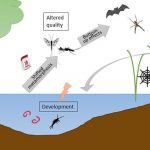
We offer a master thesis at the University of Koblenz-Landau (Campus Landau) to develop a method determining multiple energy reserves in one insect sample. It will be used as tool to investigate changes in the subsidy quality of stressed systems.
Continue reading