The Federal Institute of Hydrology offers two PhD positions (m/f/d) in the field of aquatic chemistry and aquatic ecotoxicology.
Continue readingOpen PhD positions at the Federal Institute of Hydrology (Koblenz, Germany)

The Federal Institute of Hydrology offers two PhD positions (m/f/d) in the field of aquatic chemistry and aquatic ecotoxicology.
Continue reading
Every Summer Semester, Ecotox Master students do a 2-month internship or AMEO (Applied Module at an External Organization). Today, Pablo da Silva Pena shares his AMEO experience working at Hydra Marine Sciences in Bühl.
Continue reading
Every Summer Semester, Ecotox Master students do a 2-month internship or AMEO (Applied Module at an External Organization). Today, Sarumi Oluwafemi shares his AMEO experience at the Helmholtz Centre for Environmental Research (UFZ) in Leipzig, working with the Department of Ecotoxicology (Systems-Ecotoxicology Working Group).
Continue reading
Every Summer Semester, Ecotox Master students do a 2-month internship or AMEO (Applied Module at an External Organization). Today, Krishna Venugopalan Variyer tells us about her AMEO experience in the Aquatic Department at the BASF Agricultural Center in Limburgerhof.
Continue reading
A new study on water monitoring data from a six decade period, highlights the challenges and opportunities of large-scale chemical monitoring and data analysis to assess environmental risks.
Continue reading
In this blogpost, Anastasia Manjavidze shares her internship experience at NIVA, Oslo (Norway). Students of the Environmental Pollution Management (Ecotoxicology) Program complete an 8-week internship each year, the so-called “AMEO”. The AMEO is performed either at an external university, governmental or industrial research institute where students learn to apply the competences achieved during their study. Students also use this opportunity to travel and explore not only Germany, but also other countries!
Continue reading
In this blogpost, Larissa Herrmann talks about her latest research on pesticide reoccurrence in European surface waters, revealing that over 76% of compounds reoccur in aquatic ecosystems, with 40% previously unknown for long-term pollution. Her study, conservative in scope, highlights the need to reassess environmental risks, emphasizing the importance of understanding the long-term occurrence of pesticide impacts on water ecosystems.
Continue reading
In this blogpost, Sadia Rahat shares her internship experience at Eurofins. Students of the Environmental Pollution Management (Ecotoxicology) Program complete an 8-week internship each year, the so-called “AMEO”. The AMEO is performed either at an external university, governmental or industrial research institute where students learn to apply the competences achieved during their study. Students also use this opportunity to travel and explore Germany.
Continue reading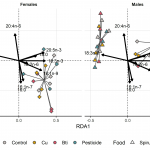
Anthropogenic stressors have a significant impact on the delicate balance of ecosystems such as emergence of aquatic insects, connecting aquatic and terrestrial food webs. These insects act as a high-quality food source for terrestrial consumers, such as spiders. In this blogpost, Sebastian Pietz talks about his latest publication on exploring the potential effects of subsidy quality on spiders.
Continue reading
Ghent University is accepting applications for a PhD Fellowship (4 years) on a project related to bioavailability of silver for freshwater organisms. The position starts ideally on 1st October, 2023.
Continue reading