In this post, Sebastian Stehle informs about their recent paper “Aquatic pesticide exposure in the U.S. as a result of non-agricultural uses“.
Continue readingUrban Pesticide Uses in the U.S. – A Risk for Aquatic Ecosystems?
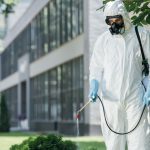

In this post, Sebastian Stehle informs about their recent paper “Aquatic pesticide exposure in the U.S. as a result of non-agricultural uses“.
Continue reading
Suitcase packed, 14-hour flight, welcome to Seoul! In this post, Verena reports on her experiences at the 5th Annual IIES Science & Policy Workshop at Korea University in November 2019.
Continue reading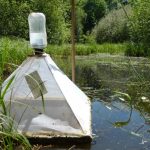
In this post, Nina Röder reports on their recently published paper “Mosquito control actions affect chironomid diversity in temporary wetlands of the Upper Rhine Valley”.
Continue reading
In this post, Verena Sesin shares her visit at the International Conference on Aquatic Invasive Species (ICAIS) in Montreal from October 27-31, 2019, a forum for new and emerging issues related to invasive species in aquatic environments.
Continue reading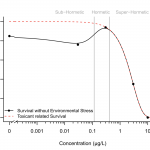
In this post, Matthias Liess introduces their recently published paper “Predicting low-concentration effects of pesticides”.
Continue reading
In this post, Carsten Brühl discusses their recently published paper “Biodiversity decline as an inappropriate environmental risk assessment of pesticides”.
Continue reading
In this post, Philipp Uhl talks about their recently published paper “The Impact of Pesticides on Flower‐Visiting Insects: A Review with Regard to European Risk Assessment”.
Continue reading
For the “Applied Module at External Organizations” (AMEO), Ecotox students complete an eight-week internship at an external university, governmental or industrial research institute. In this post, Manuel Ayala-Velázquez reports on his internship at the Université Pierre et Marie-Curie (UPMC), now Sorbonne Université.
Continue reading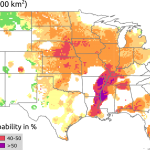
In this post, Jakob Wolfram talks about his most recent paper “Insecticide Risks in United States Surface Waters: Drivers and Spatiotemporal Modeling”. This publication analyzed the drivers of insecticide nonpoint source pollution and used a modelling approach to identify regions in the U.S. where surface waters may be at risk.
Continue reading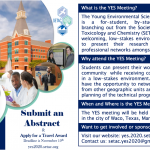
Submit your abstract to the 9th SETAC Young Environmental Scientists (YES) meeting in Waco, Texas, USA, from 9-11 March, 2020, themed “New times, new science”.
Continue reading