
Every Summer Semester, Ecotox Master students do a 2-month internship or AMEO (Applied Module at an External Organization). Today, Marie shares her AMEO experience at the German Environment Agency (Umweltbundesamt, UBA), Berlin.
My name is Marie, and I am currently a second-semester M.Sc. Ecotoxicology student. During that summer semester, I completed my mandatory 8-week internship, called AMEO, at the German Environment Agency (Umweltbundesamt, UBA) in Berlin, in the Laboratory for Water Analysis.
The UBA has offices in various cities across Germany, with its headquarters in Dessau-Roßlau. Within Berlin, offices are in Tempelhof, Dahlem and Charlottenburg, with the largest facility in Marienfelde.
I was at the Laboratory for Water Analysis in Tempelhof, Berlin. The Laboratory for Water Analysis primarily conducted research on substances such as plasticisers, PFAS, and UV filters, a project I helped with, using target analysis but also non-target screening. The team consisted of a mix of scientific and technical staff, PhD students, and trainees.
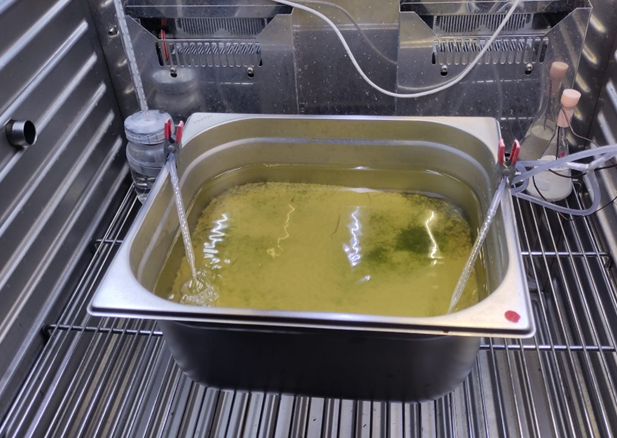
My work during the 8-week internship focused on three main areas. My primary task was to research predicted no effect concentrations (PNEC) for sediment toxicity. PNECs exist for various environmental compartments, but substances (in this case, UV filters) with high log Kow values tend to adsorb onto suspended solids in water bodies and to bioaccumulate. As a result, PNECSediment are particularly important for the risk assessment of these specific UV filters. The literature and database research identified gaps in the available sediment PNEC data. Furthermore, I visited the Marienfelde site because the German Environmental Specimen Bank (Umweltprobenbank des Bundes, German ESB) and another unit in Marienfelde jointly planned a project involving Lumbriculus variegatus, a standard test species for sediment toxicity tests, which will be exposed to contaminated suspended particulate matter (SPM) samples. I attended a meeting about this project and toured the site, including the large mesocosm systems and the Lumbriculus variegatus stock culture (Fig. 1).
Another project involved analyzing data from annual SPM samples collected by the German ESB in federal waterways. This data was then analyzed for substances typically associated with tire wear.
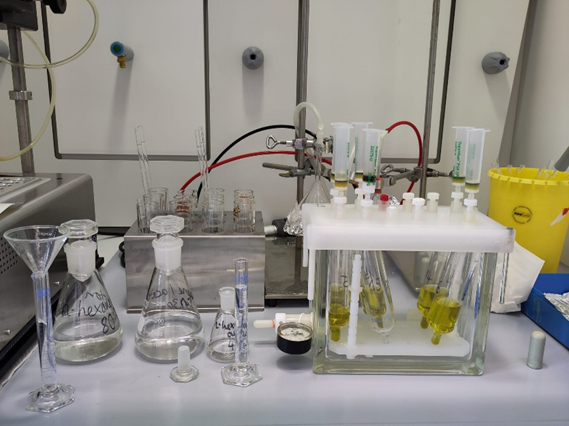
For the third project, I worked in the lab conducting recovery experiments with SPM samples. The method used was developed for organic UV filters, and the question was whether the method was also suitable for other substances. For this, the samples were spiked with defined concentrations of over 100 substances, extracted using accelerated solvent extraction (ASE), purified via solid-phase extraction (SPE) (Fig. 2), and then analyzed by LC-HRMS/MS. For the analysis, we had to drive to the Dahlem site, which gave me another opportunity to see another location.
Overall, I was very grateful for the wide range of tasks I worked on during my internship. I learned a great deal, particularly about sediment toxicity, further developed my RStudio skills, and gained more confidence in laboratory work. I not only learned a new analytical technique but also improved my understanding of laboratory workflows and working with precision and attention to detail in analysis. I also want to thank all colleagues, especially my supervisor, for their patience, support and the insights into different topics they gave me.