
Night-time lighting and invasive species are changing food webs in ways we rarely notice. In this blog post, Collins explores how artificial light at night and invasive signal crayfish reshape spider diets and alter aquatic-terrestrial resource pathways.
Did you know that artificial light at night and invasive signal crayfish (Pacifastacus leniusculus) can change what spiders eat along stream edges? The edges of rivers and streams are important areas where water and land meet, which support diverse plant and animal communities. Many animals in these areas depend on food that comes from water, such as insects emerging from rivers and streams. However, human activities such as streetlights and invasive species are becoming more common in these environments and could disrupt these important linkages.
What was done
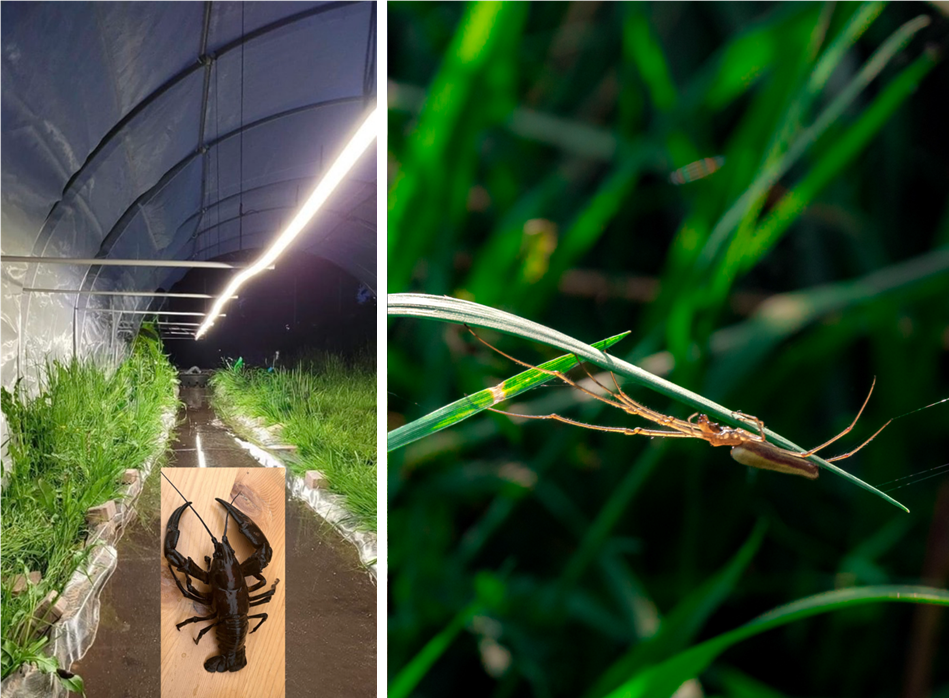
In a recent study at the Riparian Stream Mesocosm (RSM) facility near Landau, researchers tested how these stressors could affect the link between water and land. They used 16 artificial streams with adjacent shoreline habitats, mimicked streetlight-like artificial light at night (ALAN) using LED strips and introduced invasive signal crayfish in different combinations to examine how these factors interact.
Tracing spider diets with stable isotope
To understand how these changes affect the diets of animals living at the stream edge, the team focused on orb-web spiders (Tetragnatha extensa), which feed mainly on emerging aquatic insects. The researchers collected spiders, signal crayfish, and potential prey, then analyzed stable carbon and nitrogen isotopes to trace where the spiders’ food came from. This approach allowed them to reconstruct how aquatic and terrestrial resources contribute to spider diets.
Study findings
They found that spiders relied mainly on aquatic insects under all conditions. However, ALAN had a strong effect, encouraging spiders to eat a wider variety of prey. Crayfish also changed their diet under artificial light conditions, feeding more on midge larvae and small crustaceans such as gammarids. These results show that human activities like night-time lighting can cascade through ecosystems by altering animal diets and the movement of resources between water and land. Over time, this can weaken links between aquatic and terrestrial ecosystems and affect biodiversity that depends on these food resources. This study was published in Functional Ecology. A related “Behind the Paper” post is forthcoming on the journal’s website Behind the Paper blog
Study Reference:
Ogbeide, C., Arias, M., Bollinger, E., Burgazzi, G., Burgis, F., Manfrin, A., Schirmel, J., Schreiner, V.C., Bundschuh, M., & Schulz, R. (2026). Artificial light at night and invasive signal crayfish alter aquatic-terrestrial food webs. Functional Ecology. https://besjournals.onlinelibrary.wiley.com/doi/10.1111/1365-2435.70335
Technical contact:
Prof. Dr. Ralf Schulz
RPTU University Kaiserslautern-Landau
Institute for Environmental Sciences (iES Landau)
+49 (0) 6341 280-31327 | r.schulz@rptu.de
Press contact:
Kerstin Theilmann
+49 6341 280-32219 | kerstin.theilmann@rptu.de
Article by: Collins Ogbeide