
The Bund für Umwelt und Naturschutz Deutschland (BUND) has recently detected high PFAS levels in 42 out of 46 drinking water samples collected from households across Germany. They now call for a comprehensive PFAS restriction and consistent application of the polluter pays principle to protect drinking water.
How the study was conducted
From June to October 2025, BUND activists from across Germany randomly collected 46 drinking water samples. In some cases, they invited to participate in the sampling. The samples were taken from households throughout Germany and examined in an accredited laboratory for 58 different per- and polyfluorinated alkyl substances (PFAS).
The result
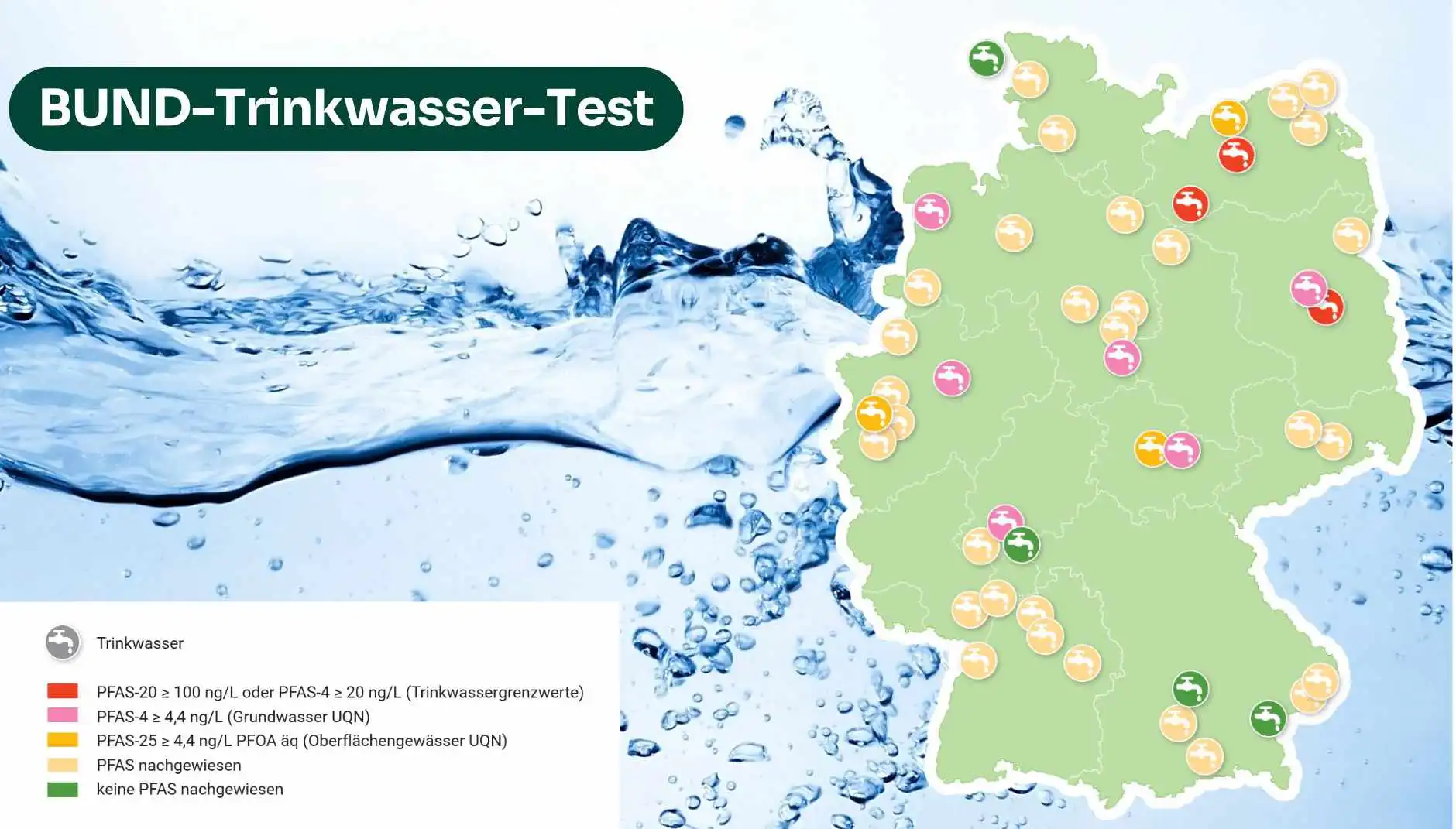
PFAS were detected in 42 of the 46 samples, meaning they were present in almost all tested samples. These were local, one-time samples from the named towns and therefore do not necessarily represent conditions across an entire city, which can vary with the water distribution network. Much of Germany’s drinking water is sourced from groundwater. The full test results can be downloaded here
Most contaminated sites
In several regions, exceedances of future PFAS limits were detected in several regions such as in Zeuthen (Brandenburg) and in Ludwigslust and Güstrow (Mecklenburg-Vorpommern). Elevated PFOA concentrations in these areas point to contaminated sites, likely due to historical use of PFAS-containing firefighting foams. A sample taken from Berlin’s government district was below the legal limit values, but the total PFAS concentration (PFAS-4 = 12 ng/L) was high enough that the Federal Institute for Risk Assessment (BfR) warns of possible health effects, such as a weakened immune system in children under ten with regular intake.
Unregulated PFAS dominates
Previously unregulated PFAS were both the most frequently detected and the most abundant in this survey. Some of these substances are being used as “replacement” chemicals for the fewer than 20 regulated PFAS. The most common replacements found were trifluoroacetate (TFA), perfluorobutanoic acid (PFBA) and perfluoropropanoic acid (PFPrA). PFPrA has so far run entirely under the radar of the authorities and is not provided for in any future measurement programs.
New PFAS limits for drinking water
New PFAS limits for drinking water will come into force in Germany in January 2026 and January 2028. Complying with these limits will present significant technical and economic challenges for water utilities. Current PFAS removal methods are expensive, resource- and energy-intensive, and are only partially effective for TFA. As Verena Graichen, BUND Managing Director for Policy, points out: “Water utilities cannot be the waste collectors for a failed chemical policy. While PFAS can be removed from drinking water through elaborate filtration, how are we supposed to address contaminated food, soils, rivers and seas? Alternatives already exist in many areas, such as textiles, cookware and refrigerants, and only a comprehensive PFAS restriction can halt the rising pollution of our environment. Politics must act to protect us all.” She also mentioned that the treatment of clean drinking water is becoming more and more expensive and expensive and the costs incurred should be paid by the polluters and not by consumers.’
More information: https://www.bund.net/service/publikationen/detail/publication/bund-pfas-wassertest-pfas-im-wasserkreislauf-angekommen/
Background
PFAS are a group of more than 10,000 synthetic chemicals often called “forever chemicals” because of their extreme persistence. They can remain in the environment for decades and accumulate in rivers, soils, food and ultimately the human body. Because of their water-, grease- and dirt-repellent properties, PFAS are widely used in products such as nonstick cookware, outdoor textiles, carpets, pesticides and refrigerants.