
Every Summer Semester, Ecotox Master students do a 2-month internship or AMEO (Applied Module at an External Organization). Today, Tithi Paul shares her AMEO experience working on the ExStream project within the RESIST research group at Roßbach, Biebergemünd.
My name is Tithi Paul, and I am currently pursuing my MSc in Environmental Pollution Management (Ecotoxicology) at RPTU. For my AMEO internship I joined RESIST, a Collaborative Research Centre that addresses the impacts of multiple stressors on streams and rivers. Within RESIST, I spent nine weeks working in the ExStream project in Biebergemünd Roßbach. ExStream is a large outdoor mesocosm system in which river water is directed into experimental channels, providing the opportunity to simulate natural conditions and assesses the effects of stressors such as warming and drought on freshwater communities.
The first two weeks were dedicated to the construction phase. Together with my colleagues, I helped in installing pumps to draw water from the river, set up sediment traps to remove suspended material, and connected header tanks to distribute the water into six large scaffolding blocks. Each block contained ten experimental channels, resulting in more than sixty artificial streams. To mimic natural habitats, the channels were filled with thoroughly washed stones of different sizes, and a drainage system was established to maintain stable conditions. This stage demonstrated the scale of logistical preparation required before an experiment of this type can begin.
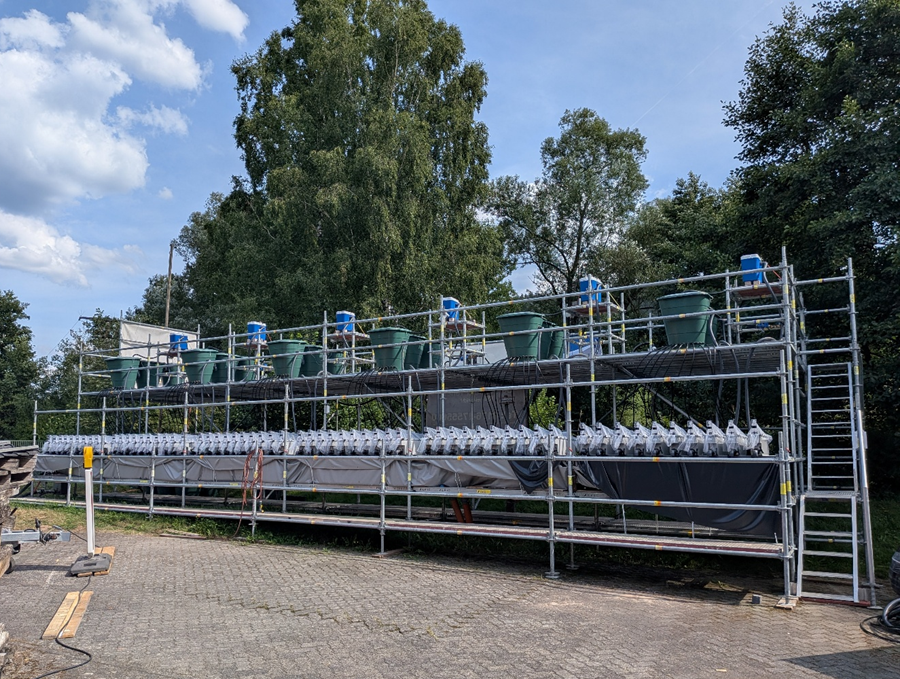
The next stage was the acclimation and seeding phase. To introduce macroinvertebrates into the system, basoms (brooms made of dried tree branches) were placed in the river and later retrieved. These provided an effective and efficient method for collecting large numbers of individuals. Once transferred, the animals were distributed among the channels to establish communities. In addition, habitat leaf tubes were placed in the channels, serving as a food source.
The experiment proceeded with the heating phase. All odd-numbered blocks were supplied with water approximately four degrees above ambient stream temperature. Every two days drift socks from the outflow were sampled to record individuals that drifted away. Emergence traps were installed above the channels to collect insects as they developed. At this stage, we also introduced two different types of leaf tubes into the channels, one with coarse mesh and one with fine mesh, to run a leaf litter decomposition experiment.
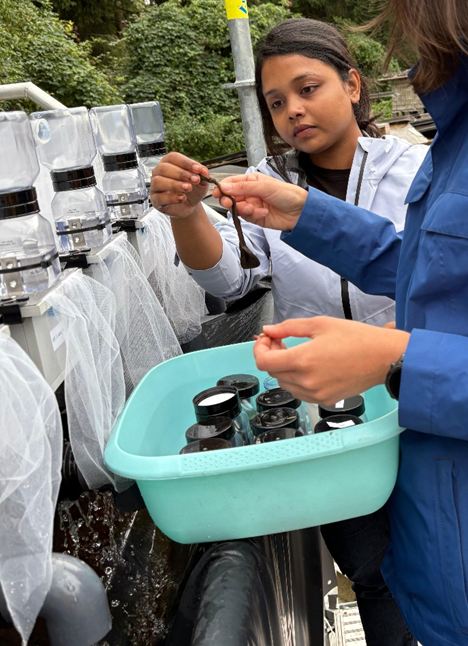
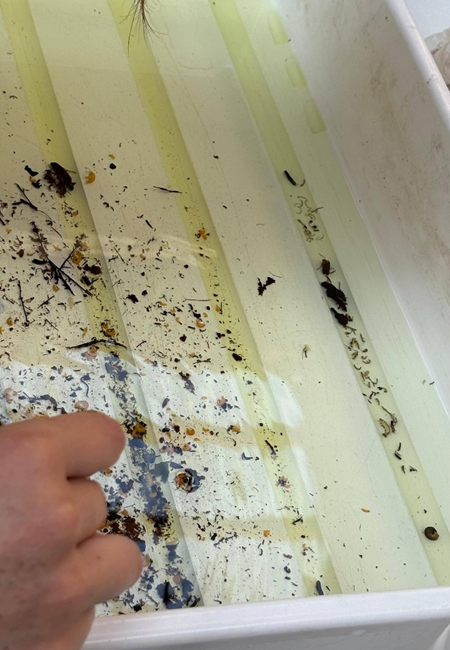
In the subsequent drought phase, randomly selected channels were subjected to surface-flow cessation. This design created multiple treatment combinations, with some channels experiencing only warming, some only drought, and others both simultaneously. This phase was the most intensive in terms of sampling. On each collection day, drift socks, leaf tubes, and emergence traps were processed, and additional measurements were taken, including algae plates, biofilm scrapes, sediment samples, and eDNA filtered from the water. Finally, entire channels were disconnected and destructively sampled to obtain comprehensive community data. Sample preservation required regular ethanol exchanges, which were conducted in cooperation with the Senckenberg Institute in Gelnhausen.
The deconstruction phase concluded the experiment. All channels were dismantled, fittings were cleaned, and equipment was carefully stored for future use. Although physically demanding, this stage yielded significant understanding of the full operational cycle of a mesocosm experiment, from initial construction to closure.
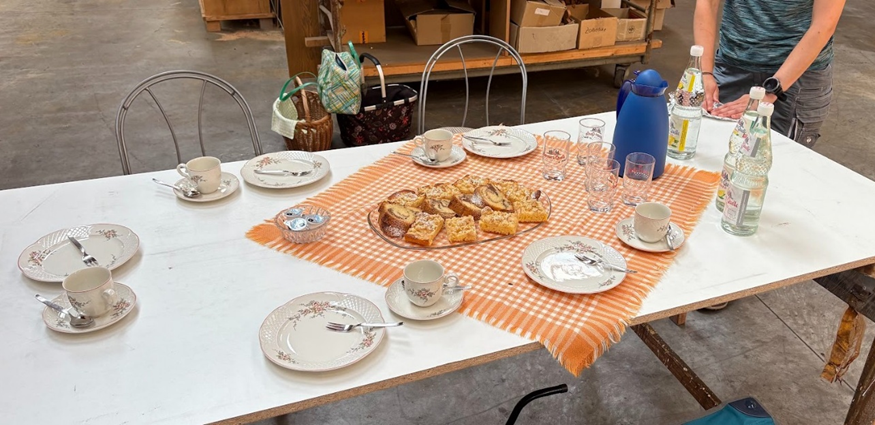
A defining feature of this internship was the supportive working environment. My supervisor and colleagues consistently provided guidance and answered questions, which allowed me to develop confidence in handling diverse methods. Equally important was the contribution of the company Holz Sinsel, which hosted the experimental system. Their generosity created a positive atmosphere throughout the project, with Mrs. Sinsel often surprising us with coffee and homemade cakes.
Overall, my AMEO at ExStream was demanding but highly instructive. I gained practical experience in constructing and maintaining mesocosm systems, applied a wide range of sampling techniques, and learned to coordinate within a large research team, which strengthened my methodological and organizational skills.
Although the internship was not financially compensated, my food and accommodation were fully funded by RESIST. I am grateful for the opportunity to contribute, and I aspire to further develop as an ecotoxicologist through this experience.